
If you have heard the word decoding and were not sure exactly what it meant, you are not alone. Teachers use it. Reading researchers talk about it constantly. And if your child is struggling with reading, there is a good chance decoding is at the center of what needs to change.
This article explains what decoding actually is, why it matters so much, what it is not, and how you can help your child build this skill starting today.
What Decoding Actually Means
Decoding is the process of reading a word by breaking it into its individual sounds and blending those sounds together from left to right until the word clicks. It is not guessing. It is not recognizing a word by its shape. It is not looking at the picture on the page and making a reasonable prediction. It is reading the actual letters in the actual word and converting them into sounds.
When a child looks at the word HAT and says the sound H makes, then the sound A makes, then the sound T makes, and blends them together into "hat," that is decoding. They looked at each letter, recalled the sound it makes, and blended those sounds into a word. That is the core skill that turns a non-reader into a reader.
It sounds simple when you break it down like that. But for a young child who has not yet been taught how letters connect to sounds, it is anything but automatic. Decoding has to be shown and practiced. It does not happen on its own.
Why Decoding Matters So Much
A child who can decode can read any word they have never seen before. They do not need to have encountered it previously. They do not need to recognize its shape. They look at the letters, apply the sounds they know, blend them together, and arrive at the word. That skill transfers to every word in every book at every level.
A child who relies on guessing or memorizing words by shape has a ceiling. In the early years, guessing often works well enough. Picture books carry a lot of context. The vocabulary is predictable. A smart child can get through a lot of stories without truly decoding a single word.
But as books get longer, the pictures disappear, the vocabulary becomes less familiar, and the guessing strategy stops working. The child who was reading confidently in first grade starts to struggle in second or third. This is not a sudden problem. It is a foundation problem that was always there, just not visible yet.
Decoding does not have that ceiling. A child who can decode keeps up as the words get harder because they have a method for tackling any word they meet, not just the ones they have seen before.
What Decoding Is Not
Understanding what decoding is not is just as important as understanding what it is. Children develop these fallback strategies naturally when they have not been shown how to decode. They are not signs that a child is not smart. They are signs that explicit decoding instruction is needed.
🚫 Memorizing word shapes. Some children learn to recognize words by their overall shape or length rather than by the letters inside them. This can look like reading because the child produces the correct word. But remove the visual context or change the font and the strategy breaks down. Shape recognition is not phonic decoding.
🚫 Guessing from the first letter. A child might see the word HAT, notice it starts with H, and say "house" because house also starts with H and fits the story. This is not decoding. It is guessing with one piece of letter information rather than working through all of them.
🚫 Guessing from pictures. A child who looks at the illustration before reading the word on the line is using the picture as a clue rather than the letters. This feels like reading and often produces a plausible answer, but it is prediction, not decoding.
How Decoding Is Taught
Decoding is taught through phonics. Specifically through two things: letter sound knowledge and blending.
Letter sound knowledge is knowing what sound each letter makes. Not the letter name. The sound. These are two different things and the difference matters more than most parents realize.
When you sing the alphabet song, you are teaching letter names. A, B, C, D. Those are names. But the letter B does not make a "bee" sound when you read. It makes a short punchy sound, like the beginning of the word ball or bat. The letter M does not make an "em" sound. It makes the sound at the beginning of the word moon or map. The letter H sounds like a quiet breath, like the start of the word hat. The letter A in a short word makes the sound in the middle of the word cat or bag. The letter T makes a quick sharp sound, like the start of the word top.
A child who knows the sound each letter makes has the raw material for decoding. Without this knowledge, blending is not possible.
Blending is the process of sliding those individual sounds together into a word. Take the word HAT. If your child knows the sound H makes, the sound A makes, and the sound T makes, blending means connecting those sounds from left to right, starting slowly and speeding up until the whole word clicks together. H... A... T... hat. The sounds do not stay separate. They flow into each other until the word emerges.
This takes practice. A lot of it. But once it clicks, it applies to every word a child will ever encounter.
Both of these skills have to be taught directly. A child does not develop letter sound knowledge by being read to. They do not develop blending by playing a reading game. These skills require explicit instruction, clear modeling, and repeated practice with a present adult who can guide the process.
The Parent's Role in Building Decoding Skills
Decoding is best learned when a parent is in the room. Not because a parent needs to be a trained teacher, but because the process of decoding requires active guidance, especially at the beginning.
When you sit with your child, point to each letter in a word, say the sound clearly, and then demonstrate blending by sliding your finger under the letters as the sounds flow together, you are doing something no app or screen can replicate. You are showing your child exactly how decoding works in real time. You are there to catch the moment they guess instead of decode, slow them down, and redirect them back to the letters. You are there to celebrate when the word clicks.
That presence is not optional. It is the ingredient that makes the practice stick.
A child who practices decoding consistently with a present parent will make steady progress. A child who is occasionally handed a tool and left alone with it will not build the skill the same way. The tool can support the practice. The parent is what makes it work.
How the Phonics Trainer Supports Decoding
Doing this on paper works perfectly and you should keep doing it. But coming up with new words every day, keeping track of what your child has practiced, and maintaining a fresh supply of material can start to feel like a lot. That is where a structured tool helps. The Phonics Trainer inside Phonics Factory at Lotty Learns is built around the exact process you would use on paper: letter sounds first, blending second.
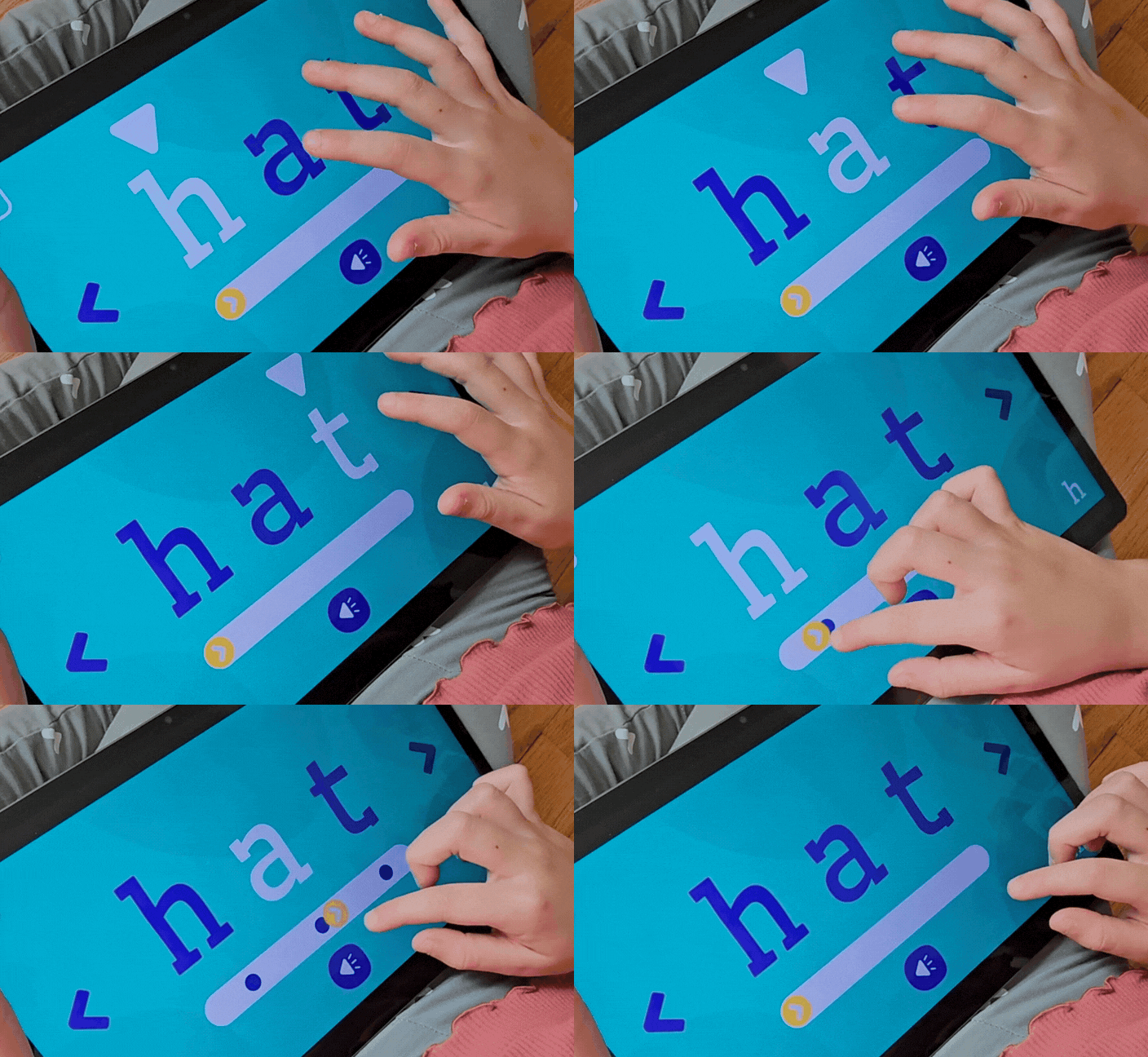
A full word appears on screen. Your child can tap each letter individually to hear its sound, confirming they know it before any blending happens. Then the blending slider moves across the word from left to right, lighting up each letter as a cue for when to say that sound. Start the slider slowly, saying each sound as the letter lights up. Then move it faster and faster until the sounds flow together into the word.
That is decoding made interactive and repeatable. With over 900 decodable words across every level of phonics complexity, from simple two and three letter patterns all the way through more advanced ones, there is no shortage of material to practice with. And because the tools are designed for a parent and child to use together, you are right there in the process the whole time. Modeling. Guiding. Celebrating the moments when it clicks.
Try Phonics Factory free for 7 days at lottylearns.com
What Decoding Looks Like When It Clicks
Every parent who has been present for the moment decoding clicks describes it the same way. The child is working through a word slowly. You can see them thinking. And then the word just comes out whole, like it assembled itself. They say it again, faster this time, with a look of genuine surprise. They did not guess. They read it.
That moment is unmistakable. And once it happens, the child wants to do it again. The satisfaction of actually decoding a word is different from the satisfaction of getting a question right in a game. It feels like something they did themselves, because it is.
Getting to that moment requires practice. Consistent, patient, parent-guided practice with real words. It does not happen in one session. It builds over weeks of showing up, modeling the process, keeping sessions short and positive, and trusting that repetition is working even on the days when it does not feel like it.
But it gets there. And when it does, a child who could not read becomes a child who can decode any word they meet. That is what decoding is. And that is what you are working toward every time you sit down with your child and show them how it works.

Frequently Asked Questions
What is the difference between decoding and reading?
Decoding is the essential foundation. True reading requires both decoding the words and understanding their meaning, but a child cannot comprehend a word they cannot first decode. When a child decodes a word, they are converting the letters into sounds and blending those sounds into a word. That mechanical skill is what makes comprehension possible. A child who cannot decode cannot truly read, regardless of how many words they have memorized.
At what age should a child start learning to decode?
Children can begin building the foundations of decoding, starting with individual letter sounds, earlier than most parents expect. There is no single right age. What matters is paying attention to when your child shows curiosity about letters and sounds, and having the right tools ready when they do. Many children are ready to begin exploring letter sounds well before they turn three. The timeline varies for every child.
My child memorizes words quickly. Is that the same as decoding?
No. Memorizing a word and decoding a word are different skills. A child who has memorized the word "dog" recognizes it by its visual shape. A child who can decode "dog" can look at any arrangement of D, O, and G and arrive at the word through the sounds. Memorization has limits. Decoding does not. As words get longer and less familiar, memorization stops working and decoding becomes the only reliable strategy.
How long does it take to learn to decode?
It varies depending on the child's age, readiness, and how consistently they practice. Many children begin showing early signs of decoding ability within a few weeks of regular, focused practice. Building full decoding fluency across all phonics patterns takes longer and develops over months of consistent work. Short daily sessions with a present parent tend to produce stronger results than occasional longer sessions.
What if my child already uses a reading app? Is that enough?
It depends on what the app is actually doing. Many reading apps focus on word recognition, picture matching, or reward-based games that do not require a child to decode. If your child cannot sound out a word they have never seen before, the app may be building familiarity without building the underlying decoding skill. Real decoding practice requires your child to engage with letters and sounds directly, ideally with a parent present to guide the process.
Can I teach decoding at home without any special materials?
Yes. A piece of paper and a pencil is enough to start. Write a simple three letter word like HAT or CUP. Point to each letter and say its sound. Then slide your finger under the word as you blend the sounds together. Let your child watch you do this several times before asking them to try. That is decoding practice. The materials matter far less than the consistency of the practice and the presence of a parent who models the process clearly.
What is the difference between phonics and decoding?
Phonics is the system that connects letters to sounds. Decoding is what a child does when they apply that system to read a word. Phonics is the knowledge. Decoding is the skill. Teaching phonics gives a child the building blocks. Decoding practice is how they learn to use those blocks to read real words. Both are essential and they develop together through consistent, focused practice.