
How to Teach Your Child to Read at Home Even If You Are Not a Teacher
Most parents who want to teach their child to read talk themselves out of it before they even start. They assume reading instruction belongs in a classroom, delivered by someone with a degree and a lesson plan. So they hand their child a reading app, hope for the best, and wait for school to take over.
But here is the truth: you do not need a teaching degree to teach your child to read. You do not need any special training or a room full of materials either. What you need is a piece of paper, ten minutes, and a willingness to sit beside your child and show them how words work.
That is the core of the method. A present parent, a simple word, and the willingness to model the process. From there, everything builds with practice.
Why You Are More Qualified Than You Think
One of the most important things a child needs when starting the reading journey is not someone with a teaching degree. It is a present, engaged adult who makes the process feel safe and worthwhile. That is something every parent can be.
You do not need to worry about anything beyond this right now. Reading has a lot of layers but they all become much easier once this foundation is in place. The first thing to focus on is simple: your child being able to look at a word, sound it out, and read it. And getting there does not require a teaching degree. It requires a parent who shows up and tries.
Think about how children learn to talk. No parent takes a course in language development before teaching their child to say their first words. They just talk to them, repeat things, point at objects, and respond when the child tries. The child learns because a trusted adult is right there showing them how it works.
Learning to read requires more direct instruction than learning to speak, but the same quality of parent interaction matters just as much. You show your child how sounds connect to letters. You demonstrate how those sounds blend together into words. You celebrate when something clicks. Your child learns because you are there doing it with them.
The parent who shows up consistently and makes reading practice feel positive gives their child a strong chance of success. The parent who waits until they feel ready will wait a long time.
What a Real Reading Session Looks Like
You do not need anything fancy to start teaching your child to read. Grab a piece of paper, a chalkboard, or a whiteboard. That is all you need to get started.
Write a simple three letter word. HAT. CAT. BUS. CUP. Something short and clean with no silent letters or unusual patterns.
Now point to each letter from left to right and say the sound it makes. Slowly and clearly. Not the letter name. The sound. H makes a /h/ sound. A makes a short /a/ sound. T makes a /t/ sound.
Do this yourself first. Let your child watch you. This is called modelling and it is one of the most powerful things a parent can do. When a child watches a trusted adult work through a word sound by sound, they see that reading is not magic. Words are just sounds lined up in a row, waiting to be decoded, sounded out one by one. Watching a parent do it first removes the mystery.
Once you have pointed to each sound separately, show your child what blending looks like. Stretch the sounds slowly toward each other. /h/... /a/... /t/... hat. Say it slowly at first, then gradually faster, until the word clicks together. Repeat this several times before asking your child to try it themselves. Watching comes before doing. That sequence matters.
When your child is ready to try, stay right beside them. If they get it right, celebrate it. If they do not, model it again. There is no penalty for needing another demonstration. That is just how learning works.
Start Simple and Let Reading Build Naturally
The goal at the beginning is not to cover a lot of ground quickly. It is to get one thing to click: individual sounds can be put together to make a word. That single understanding is the foundation everything else is built on.
Start with the simplest words available. Short combinations of two or three sounds that give your child a clear, clean demonstration of how blending works. Simple three letter words like CUP, HAT, BIG, and RUN are the ideal starting point. They follow a predictable pattern and they are easy to decode once a child understands the process.
Once your child is consistently reading simple words without hesitation, you can introduce more complex ones. Words where two letters make one sound together, like CHIP or SHIP. Words where a silent letter at the end changes the vowel sound, turning CAP into CAPE or HOP into HOPE. Words where the vowel sound shifts because of the letter R, like CAR, BIRD, and CORN.
Each of these patterns builds on the last. A child who has mastered simple three letter words has the blending reflex already in place. The more complex patterns are just new information layered on top of a solid foundation. There is no rush to get there. Mastering the basics first is what makes every next step easier.
Follow your child's readiness, not an arbitrary timeline.
The Moment Reading Clicks
Every parent who has taught a child to read at home describes the same moment. The child is working through a word, sliding the sounds together slowly, and then suddenly the word just comes out whole. Their eyes go wide. They say it again, faster this time, like they cannot quite believe it worked. That is the moment blending becomes reading.
That moment is what you are working toward in every session. It does not happen on the first day or even the first week. It happens after enough consistent practice that the process becomes automatic. But when it happens it is unmistakable, and once it happens, the child wants to do it again.
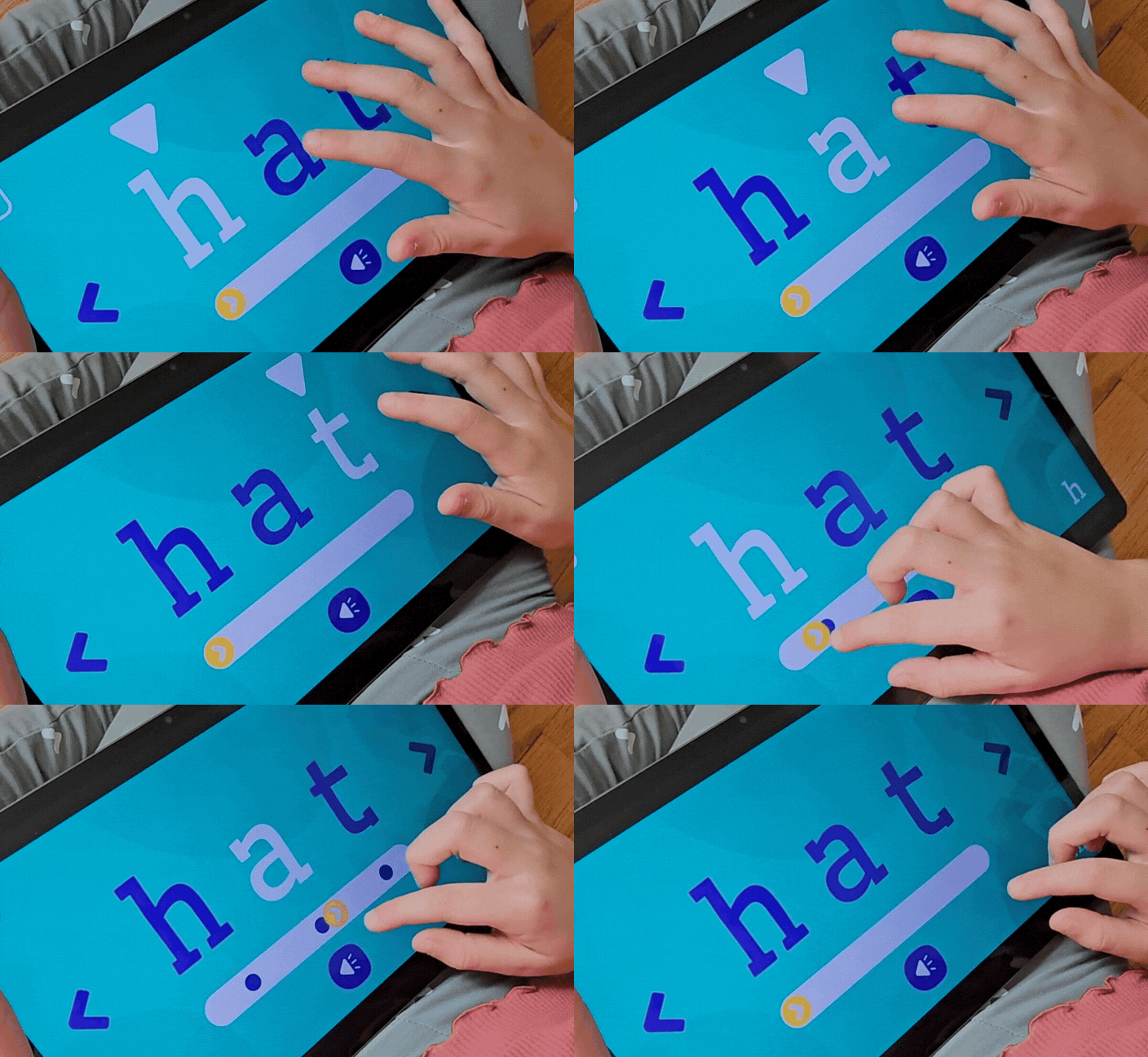
This is exactly what the Phonics Trainer inside Lotty Learns is designed to bring about. Your child can tap each letter in a word to hear its individual sound, which reinforces the connection between the written letter and the sound it makes. Then they use the blending slider to practice putting those sounds together. As the slider moves across the word it lights up each letter, signalling when to say that letter sound. The child slides slowly at first, saying each sound as it lights up, then gradually faster and faster until the sounds blend into the full word.
That moment when the sounds click together into a word your child recognizes is the same moment you are creating on paper at home. The tool just gives you over 900 decodable words to practice with, across every level of reading complexity, from the simplest patterns all the way through more advanced ones. And because it is designed for parents and children to use together, you stay right in the process the whole time.
No Tool or Program Works Without You in the Room
This is worth saying plainly because it is the thing most parents do not hear until their child has been using a reading app alone for months without making real progress.
Most tools are far more effective with a parent involved. The tool makes the process simpler and more engaging. The parent makes it work.
When you are in the room you catch the moments when your child guesses at a word instead of sounding it out. You notice when they are moving too fast and not actually engaging with each sound. You redirect before a shortcut becomes a habit. You provide the encouragement that keeps a child trying when a word is hard. None of that happens when a child is sitting alone with a screen.
You are the teacher. The tool is just what makes it easier to teach.
This is also why you do not need a formal program to teach your child to read. Some progression in what you practice helps, but it does not need to look like school. What gets results is repeated, guided time with real words alongside a present parent. Once a child understands how sounds blend together, the next steps become easier to build on. You follow their readiness, keep the sessions short and positive, and show up every day. That is the approach.
Keep Sessions Short and the Tone Positive
Ten minutes of focused reading practice every day is more valuable than one long session once a week. Young children do not need extended study time. They need consistent, positive repetition that builds on itself over time. Ten minutes daily, done regularly, can lead to meaningful progress and early reading ability. An occasional long session does not produce the same results.
Your attitude during those ten minutes sets the tone for everything. Children are extremely sensitive to how a parent feels about an activity. If you bring genuine enthusiasm to reading practice, your child mirrors it. If you bring tension or impatience, your child mirrors that too.
Celebrate every small win, no matter how small. When your child sounds out a word correctly for the first time, make it a moment. When they read a word today that they struggled with yesterday, tell them you noticed. These small celebrations are not empty praise. They are the signal that keeps a child coming back to the table willingly tomorrow.
And if a session is not going well, stop. Put the paper down and try again tomorrow. Pressure and frustration are the enemies of reading progress. A child who associates reading practice with stress will avoid it. A child who associates it with connection and small victories will ask for it.
Consistency Is What Produces a Reader
The parents who successfully teach their children to read at home are not the ones who found the most sophisticated program or the cleverest app. They are the ones who showed up every day.
Results do not come from trying something twice and waiting to see what happens. They come from a parent who makes ten minutes of reading practice a consistent part of the day, week after week. That consistency is what moves a child from struggling with individual sounds to blending words confidently to reading sentences they have never seen before.
You do not need to be a teacher to do this. You need to be present. You need to be consistent.
Phonics Factory at Lotty Learns gives you the tools to make those ten minutes count every day. Interactive decodable word practice with a blending slider that makes the reading process visible and concrete, over 900 words across every level of complexity, and a calm focused environment designed for a parent and child to use together. No games. No guessing. Just real reading practice, built for parents who want to be in the room.
Try it free for 7 days at lottylearns.com
Frequently Asked Questions
Do I need any teaching experience to teach my child to read at home?
No. Teaching your child to read does not require a background in education. It requires showing up consistently, demonstrating how sounds blend together into words, and keeping sessions short and positive. The method is simple enough that any parent can do it. What matters far more than any qualification is presence and consistency.
What materials do I need to get started?
Nothing complicated. A piece of paper and a pencil is enough to run a reading session. Write a simple three letter word, point to each sound from left to right, and show your child how blending works. A whiteboard or chalkboard works well too since you can write and erase quickly. The material is not the point. The interaction between you and your child is.
How do I know which words to start with?
Start with simple three letter words that follow a clear pattern: HAT, CUP, BIG, RUN, PET. These give your child the clearest possible demonstration of how individual sounds blend into a word. Once they are blending these confidently, you can move to more complex words. There is no rush. Getting the basics solid first is what makes every next step easier.
What if my child gets frustrated during a session?
Stop the session and try again tomorrow. Frustration is a signal that the child is not in the right state to learn, and pushing through it creates negative associations with reading. Come back the next day with a fresh start and a simpler word if needed. Short positive sessions done consistently will always outperform long sessions that end badly.
How long does it take before my child can actually read?
Many children begin showing early signs of progress within a few weeks of consistent practice. The timeline varies depending on the child's age, readiness, and how regularly practice happens. Ten minutes a day done consistently tends to produce stronger results than occasional longer sessions. The key is showing up regularly, not finding more time in a single sitting.
Can my child learn to read using just paper and pencil, or do they need a tool?
Paper and pencil practice alone is genuinely effective. It keeps things simple and requires direct engagement with the sounds. An interactive tool like Phonics Factory adds a layer of engagement and gives you a much larger bank of words to work through. The best approach is to start with the paper method so your child understands the blending process, then use an interactive tool to extend and reinforce that practice over time.
Why does my child need me in the room? Can they not just use a reading program on their own?
Most tools are far more effective with a parent involved. When you are present you catch the moments when your child guesses instead of sounding out, you provide encouragement when a word is hard, and you redirect when they rush through without truly engaging. The parent is what makes any tool or program work well.
What if we miss a few days?
Pick up where you left off and keep going. Missing a day or two does not undo progress. What matters is the overall pattern of consistency over time. A child who practices most days each week will make strong progress. A child who practices sporadically will not. Do not let a missed day become a reason to stop altogether.