
Why Is My Child Guessing Words Instead of Sounding Them Out?

You hand your child a book. They scan the page, glance at the picture, and confidently say a word that fits the story but has nothing to do with the letters on the page. It looks like reading. It sounds like reading. But it is not reading.
If this sounds familiar, you are not imagining a problem. You are seeing one. And the sooner you understand what is actually happening, the sooner you can do something about it.
This article explains why children guess at words instead of decoding them, what the research says about where that habit comes from, and what focused phonics practice looks like when it is done in a way that actually sticks.
What Is Happening When a Child Guesses at Words
Reading researchers have a name for the guessing strategy: cueing. Instead of sounding out the letters in a word, a child uses surrounding clues to predict what the word probably is. The picture on the page. The shape of the word. The first letter. The way the sentence is going.
None of these clues require a child to read the word. They only require a child to make a reasonable guess about it.
This distinction matters enormously. A child who guesses "puppy" when the word is "dog" is not making a reading error in the traditional sense. They are doing exactly what they have learned to do: use context to fill in the blank. The problem is that this strategy breaks down the moment the context runs out.
Picture books carry a lot of context. The illustrations are rich, the vocabulary is predictable, and a smart child can get through an entire story using nothing but inference and memory. This is why guessing can go undetected for a long time. The child seems confident. They are moving through the book. Parents hear words coming out that match the story, and they assume reading is happening.
It often is not.
Why Guessing Gets Mistaken for Reading
Children with large vocabularies and strong comprehension instincts are especially prone to this pattern. They have heard a lot of stories. They understand how sentences work. They know that certain words tend to appear in certain kinds of books. All of that knowledge makes them very good at guessing, sometimes good enough to fool even attentive parents.
The real test is not whether a child can read a familiar book. The real test is whether a child can read a word they have never seen before, with no picture beside it and no sentence around it. Write the word "lamp" on a blank piece of paper and ask your child to read it. If they can sound it out, they are decoding. If they freeze, guess randomly, or ask what it says, the guessing strategy is not transferring to real reading.
This is worth testing before you assume your child is on track. Confidence with picture books and decoding ability are two different things, and they do not always develop together.
Where the Guessing Habit Comes From
For a long time, a popular approach to early reading instruction was built around teaching children to use exactly these kinds of clues. Look at the picture. Think about what makes sense. Use the first letter as a hint. This approach, sometimes called whole language or the three-cueing system, was widely used in classrooms through the 1980s, 1990s, and into the 2000s.
The Science of Reading, a body of research that has grown significantly over the past few decades, has largely discredited this approach for teaching decoding. The National Reading Panel, which reviewed the available research in 2000, concluded that explicit, systematic phonics instruction is one of the most effective methods for developing early reading skills. That finding has been replicated many times since.
The problem is that instructional approaches take time to change. Many parents learned to read under whole-language methods. Many current early childhood programs still incorporate cueing strategies. And many children are still being taught, implicitly or explicitly, that guessing from context is a reading skill rather than a substitute for one.
If your child is a guesser, there is a good chance they learned it somewhere. That does not mean they cannot unlearn it.
What Happens If Guessing Goes Uncorrected
In the early years, guessing often works well enough that no one raises a flag. A child moves through kindergarten and first grade looking like a reader. Teachers see engagement. Parents see confidence. Report cards come home with encouraging notes.
Then the books get harder.
Reading researchers have documented a pattern sometimes called the "fourth grade slump," in which children who appeared to be reading well in the early grades begin to struggle significantly as texts become longer, more complex, and less heavily illustrated. The context clues that carried them through picture books are no longer available. The vocabulary is less familiar. The pictures are gone. And the decoding foundation that was never built is suddenly, visibly absent.
This is not inevitable. But it is common. And it is almost always traceable back to a gap in early phonics instruction.
The children who do not hit this wall are the ones who learned to decode, who were taught to look at letters, connect them to sounds, and blend those sounds into words. That skill transfers to every word in every book at every level. Guessing does not.

What Real Phonics Practice Looks Like
Teaching a child to decode does not require a teaching degree. It requires understanding what the practice actually looks like and doing it consistently.
Letter sounds before letter names. The letter B is not "bee." It makes a /b/ sound. When a child is learning to decode, what matters is that they can connect a visual symbol to a sound. The name of the letter is secondary. Many children know every letter name by heart and still cannot blend sounds into words, because names and sounds are different pieces of knowledge.
Blending practice. Blending is the process of taking individual sounds and sliding them together to form a word. /c/ /a/ /t/. Cat. This is the mechanical core of decoding, and it needs to be practiced out loud, repeatedly, and with words the child has not memorized. It is a skill, and like every skill it improves with focused repetition.
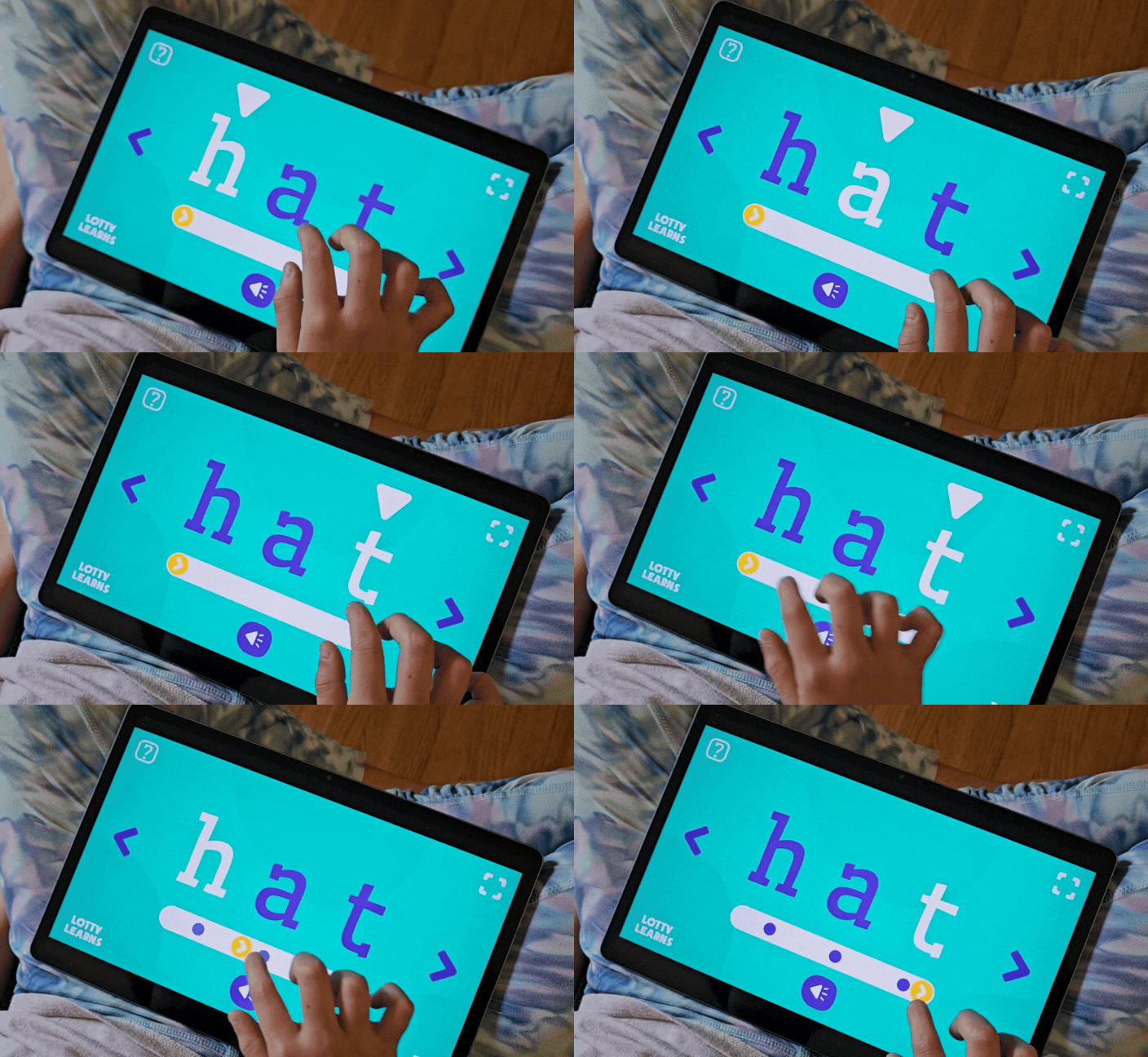
Words in isolation. The single most important change you can make to at-home reading practice is removing the context clues. Practice with words that have no picture beside them. Use flashcards, write words on paper, or use a tool that presents words without illustrations. If your child can only read a word when it sits beside a picture of the thing it names, they are not decoding that word.
Short sessions, done consistently. Research on skill acquisition in young children consistently supports brief, focused practice over long, passive sessions. Ten minutes of genuine phonics interaction, where your child is actively working with sounds and letters, is worth more than an hour of a child moving through an app that does not require real decoding.
Parent involvement. A child learning to decode needs someone in the room. Not because the parent needs to teach every phonics rule, but because the guessing habit is persistent and subtle. When a child glances at a picture before reading a word, or substitutes a synonym that fits the sentence, a present parent can catch it and redirect. A screen cannot.
Why Most Reading Apps Do Not Fix This Problem
Many parents turn to reading apps hoping they will build phonics skills. Some apps are genuinely useful. But a large number of them are built around the same picture-heavy, context-rich environment that encourages guessing in the first place. If the app shows your child an image of a cat and asks them to tap the word "cat," it is not teaching decoding. It is teaching matching.
Apps that use games, points, and reward loops have an additional problem: they are designed to keep a child engaged, which is not the same as keeping a child learning. A child can rack up stars and unlock levels without ever sounding out a word they did not already know. The engagement metric looks great. The reading progress does not match it.
Real phonics practice is not always the most exciting ten minutes of a child's day. That is not a flaw. It is the nature of building a foundational skill. The payoff, a child who can pick up any book and decode words they have never seen before, is worth the focused effort.
This is the distinction that Phonics Factory at Lotty Learns is built around. Children work directly with over 900 decodable words using a blending tool that makes the sounding-out process visible, concrete, and interactive. There are no pictures to guess from. There are no reward loops pulling attention away from the letters. The tools are designed for parents and children to use together, which means the guessing moments get caught and corrected in real time.
Signs Your Child Is Guessing Instead of Decoding
If you are not sure whether your child is decoding or guessing, here is what to listen for during reading practice:
They substitute a word that makes sense in the sentence but looks different on the page ("bunny" for "rabbit," "big" for "large")
They read a familiar book smoothly but stumble over the same words in a different context
They glance at the picture before reading the word on that line
They self-correct based on whether the word fits the story rather than going back to sound it out
They can "read" a book they have heard many times but struggle with books they are encountering for the first time
They slow down significantly or shut down when there are fewer pictures on the page
Any of these is worth taking seriously. None of them means your child is behind in a permanent way. They mean your child needs more explicit phonics practice, specifically the kind that removes context clues and requires real decoding.
How to Start Shifting From Guessing to Decoding
You do not need to overhaul your child's entire reading routine. You need to add focused phonics practice to what you are already doing. Here is a simple starting framework:
Start with sounds. Before working on whole words, make sure your child knows the individual sounds each letter makes. Not the names. The sounds. Spend a few minutes each day reviewing letter sounds until they are automatic.
Practice blending with short words. Start simple. /a/ /t/. At. /s/ /a/ /t/. Sat. The goal is to build the blending reflex so it becomes the first thing your child does when they see a word, not the last resort after guessing fails.
Add words without pictures. Even if you continue reading picture books together, add a few minutes of isolated word practice. Write words on index cards or use a tool built for this purpose. The practice without pictures is what builds the skill that transfers.
Be patient with the transition. A child who has been guessing successfully for a year or two will not switch to decoding overnight. The old strategy feels easier because it has worked. Give the new strategy enough practice time to start feeling natural. That usually takes weeks, not days.
Stay in the room. Ten minutes of parent-guided phonics practice, where you are watching what your child does with each word, is more valuable than an hour of solo app time. Your presence is not optional. It is part of the method.
The Guessing Will Stop When Decoding Becomes the Better Tool
A child who guesses at words is not broken. They are resourceful. They found a strategy that worked and they are using it. The moment they have a better strategy, one that actually lets them read words they have never seen before, the guessing fades on its own.
That is what phonics instruction does. It gives children a tool that is genuinely more powerful than context guessing, and children know the difference between guessing and knowing. Once they experience the confidence of sounding out an unfamiliar word and getting it right, they want to do it again.
If your child is at this stage right now, the most useful thing you can do is start. Not next year. Not when school starts. Now. The gap between a guessing strategy and the demands of real reading grows over time, and it is much easier to close it early than to close it later.
Phonics Factory at Lotty Learns gives you the tools to do exactly that. Interactive decodable word practice, built for parents and children to use together, in ten focused minutes a day.

Frequently Asked Questions
At what age should I start worrying about my child guessing words?
If your child is regularly using pictures or context to predict words rather than sounding them out, it is worth addressing regardless of age. Children can begin learning letter sounds earlier than most parents expect. The habit of guessing is easier to replace before it becomes deeply established, so earlier is better.
How do I know if my child is guessing or actually reading?
Write a word on a blank piece of paper with no picture beside it and ask your child to read it. If they can sound it out, they are decoding. If they freeze, guess randomly, or look around for clues, they are relying on a guessing strategy rather than genuine phonics skills.
Can a child unlearn the guessing habit?
Yes. Guessing is a strategy, not a fixed trait. Once a child has real decoding tools and enough practice with words in isolation, the guessing fades naturally. It takes consistent practice over weeks, not months, and a parent nearby to redirect the habit when it kicks back in.
Do I need to be a teacher to help my child with this?
No. You do not need a teaching background or any special training. What matters is understanding what decoding practice looks like, sitting with your child during practice, and catching the moments when guessing creeps back in. Phonics Factory at Lotty Learns is designed specifically for parents who want to be involved without needing to be experts.
Why do reading apps not fix the guessing problem?
Many reading apps use pictures, context, and game mechanics that reinforce the same guessing strategies children are already using. If the app shows an image of a dog and asks your child to tap the word "dog," it is teaching picture matching, not decoding. Real phonics practice requires your child to interact with letters and sounds directly, without pictures to lean on.
How long does it take to see a shift from guessing to decoding?
Most children begin showing signs of the shift within a few weeks of consistent, focused phonics practice. Ten minutes a day is enough. The key is that the practice removes context clues and requires real sounding out rather than prediction.